
Halloween falls on a Saturday this year. Many people will use the occasion to organise a horror movie night, and someone will have to settle on a film. Usually, the conversation starts with a subgenre: some want a slasher, others a ghost story or a tale of possession.
Obsession is likely to come up. It is the biggest horror hit of 2026. Curry Barker, a former YouTuber, shot it in twenty days on a 750,000-dollar budget , and it has earned more than $520 million worldwide, making it the fifth-highest-grossing horror film of all time . In the film, a young man breaks a small object said to grant a wish and asks for his friend to love him more than anything in the world. She starts loving him exactly as he asked, and that is where the trouble begins. You could file it under witchcraft because of the cursed object, or psychological horror because everything revolves around an obsession, but neither category really describes the film.
At Gemster, we describe more than a million works for our recommendation app, from films and video games to manga, and we often run into this classification problem. So we wanted to find out whether Obsession was an isolated case.
How do we classify horror films?
Anyone who used to visit video rental shops probably remembers the horror section at the back, with tapes sorted into bins by the type of threat: masked killers on one side, ghost stories on another, and monsters a little further along. Customers knew where to look, and the shopkeeper knew where to put each new release.
Online, that role is played by a poster called “Horror Genres & Sub-Genres”, which appears everywhere from social media to poster shops. Nobody seems to know who drew it, and it is simply a fan-made infographic, yet it became influential enough for Rotten Tomatoes to use its categories to classify 1,038 horror films.
The poster divides horror into five families according to the nature of the threat. Gore covers torture, splatter and cannibalism, while psychological horror draws on madness, paranoia or fanaticism. Killer films range from the American slasher to the Italian giallo, monster films bring together vampires, zombies, animals and all kinds of creatures, and the paranormal covers ghosts, haunted houses, demons and possession.
At the bottom of the poster, one last row gathers labels that do not form a family of their own, such as comedy, science fiction, gothic horror, body horror and found footage. They can be added to any of the five families to describe the tone more precisely. The poster puts body horror among these labels rather than under gore, a debatable choice that explains why films such as The Substance or Together have no family of their own.
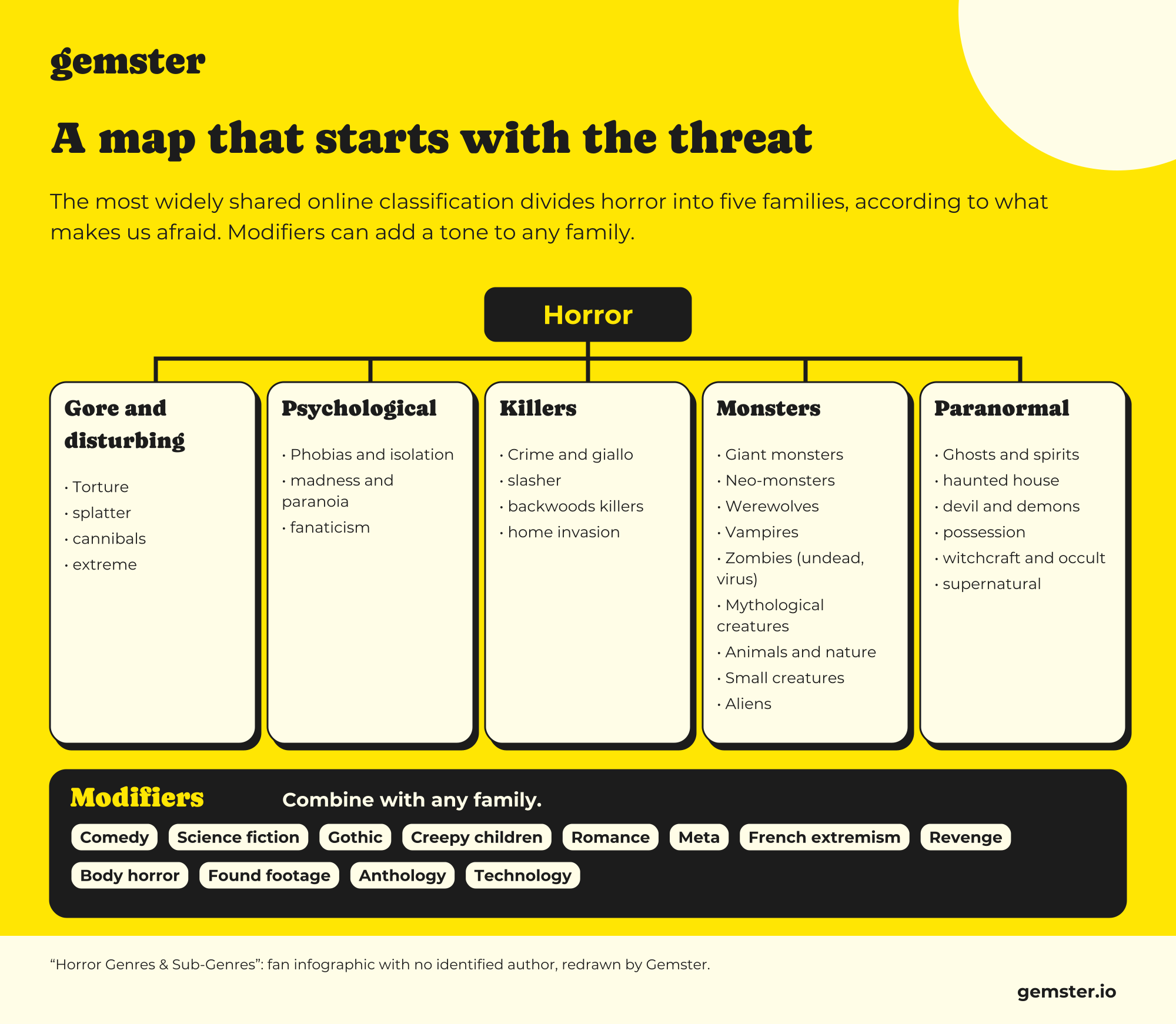
Read the diagram’s five families and modifiers
- Gore and disturbing : Torture, splatter, cannibals, extreme.
- Psychological : Phobias and isolation, madness and paranoia, fanaticism.
- Killers : Crime and giallo, slasher, backwoods killers, home invasion.
- Monsters : Giant monsters, neo-monsters, werewolves, vampires, zombies (undead, virus), mythological creatures, animals and nature, small creatures, aliens.
- Paranormal : Ghosts and spirits, haunted house, devil and demons, possession, witchcraft and occult, supernatural.
Modifiers to combine: comedy, science fiction, gothic, creepy children, romance, meta, French extremism, revenge, body horror, found footage, anthology, technology.
“Horror Genres & Sub-Genres”, a fan infographic with no identified author, redrawn by Gemster.
More scholarly classifications have existed for a long time. In his 1977 book Dark Dreams, critic Charles Derry was already describing a horror of the demonic , one of the three main branches he identified in modern horror cinema. The poster has nevertheless travelled much further, probably because it takes only seconds to understand.
Two ways to organise a film
“Every film has its box”
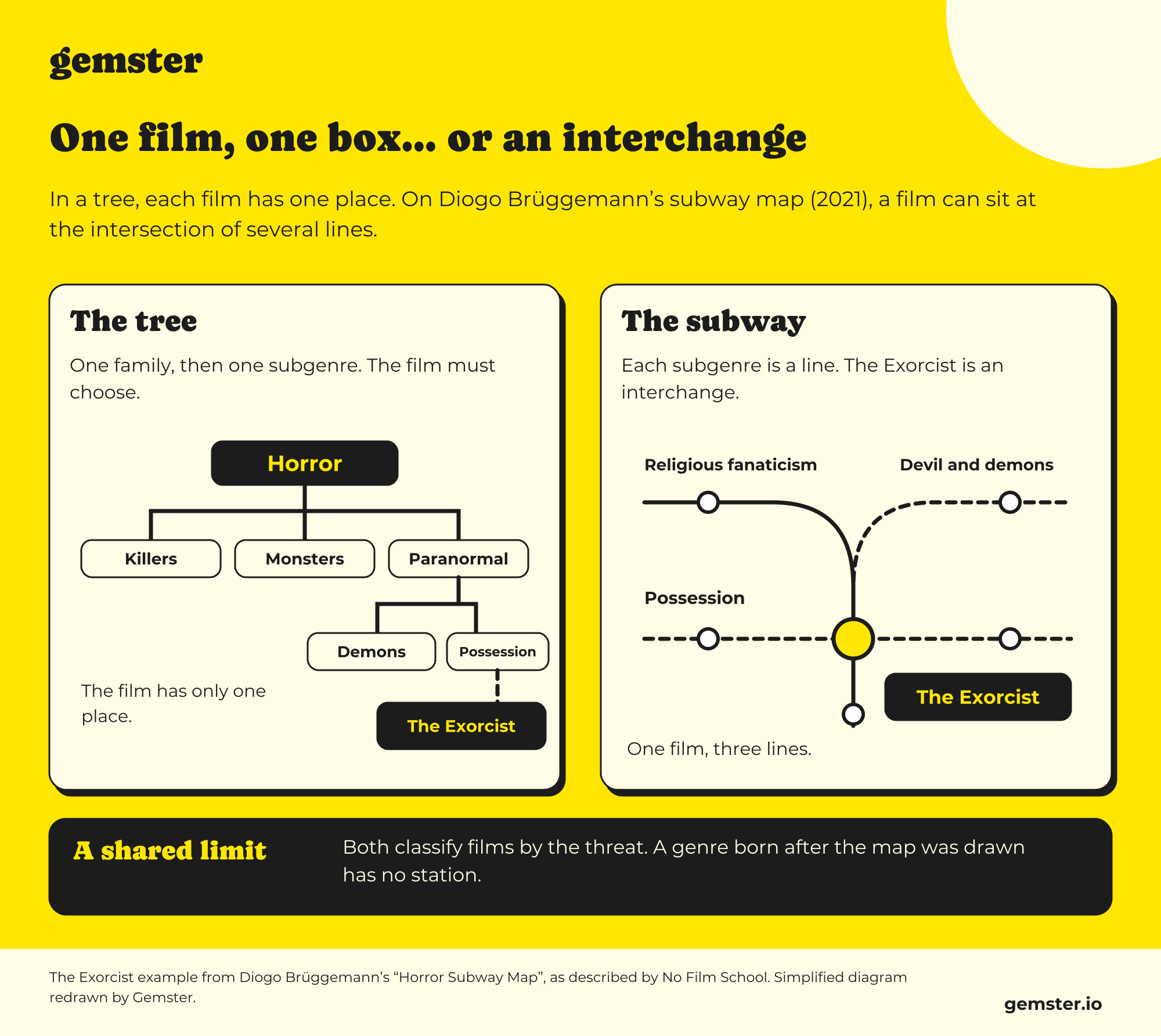
The poster works like a tree, with each film moving down from a family to a subgenre. The Exorcist falls under the paranormal, then possession.
Its strength is that you can read it at a glance and immediately distinguish a slasher from a demon film. Its weakness is that it forces a choice: a film that belongs to two families must give up one of them.
“Every film is a station”
In 2021, Diogo Brüggemann published a different representation on Twitter: his “Horror Subway Map” , where subgenres become subway lines and films become stations. The Exorcist is an interchange served by the religious fanaticism, possession and devil lines.
Its strength is that a film can exist in several places at once. Its weakness is that the lines still start from the threat, and the map remains frozen at the time it was drawn: a genre that emerges later has no station.
How do these boxes hold up against recent films?
To find out, we looked at the 33 horror films that attracted the most attention between October 2024 and October 2026, from Terrifier 3 to Clayface, combining major theatrical hits with festival discoveries. For each film, we looked for its main family on the poster, then the other families it touches, cross-referencing several reviews.
Of these 33 films, twelve have no main box on the poster, and nineteen spill into a second family, as Diogo Brüggemann’s subway map suggested they might. The web’s most widely shared classification therefore leaves out more than one recent film in three.
Gore occupies a special position: none of the films in the list uses it as its main family. It is very much present, from Terrifier 3 to Evil Dead Burn, but it always accompanies another form of fear.
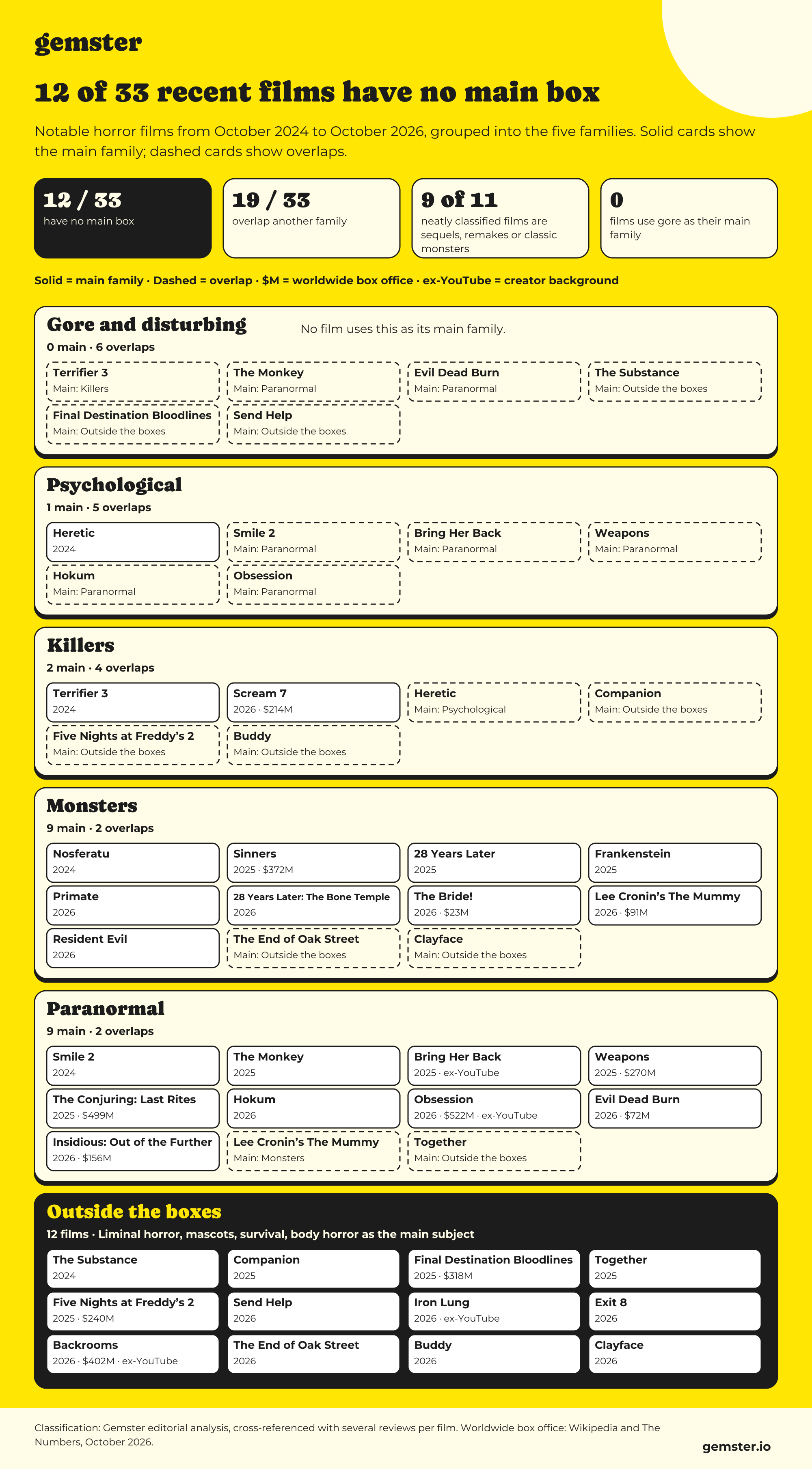
Read the full classification of all 33 films
Diagram transcript: 12 films have no main box; 19 spill into another family; 9 of the 11 films in a single family are sequels, remakes or classic monsters; no film has gore as its main family. The listed box-office figures are worldwide totals in millions of US dollars, from the October 2026 snapshot.
- Heretic (2024) — main family : Psychological; also overlaps with Killers.
- Terrifier 3 (2024) — main family : Killers; also overlaps with Gore and disturbing.
- Scream 7 (2026) — main family : Killers; 214 million dollars.
- Nosferatu (2024) — main family : Monsters.
- Sinners (2025) — main family : Monsters; 372 million dollars.
- 28 Years Later (2025) — main family : Monsters.
- Frankenstein (2025) — main family : Monsters.
- Primate (2026) — main family : Monsters.
- 28 Years Later: The Bone Temple (2026) — main family : Monsters.
- The Bride! (2026) — main family : Monsters; 23 million dollars.
- Lee Cronin’s The Mummy (2026) — main family : Monsters; also overlaps with Paranormal; 91 million dollars.
- Resident Evil (2026) — main family : Monsters.
- Smile 2 (2024) — main family : Paranormal; also overlaps with Psychological.
- The Monkey (2025) — main family : Paranormal; also overlaps with Gore and disturbing.
- Bring Her Back (2025) — main family : Paranormal; also overlaps with Psychological; YouTube creator.
- Weapons (2025) — main family : Paranormal; also overlaps with Psychological; 270 million dollars.
- The Conjuring: Last Rites (2025) — main family : Paranormal; 499 million dollars.
- Hokum (2026) — main family : Paranormal; also overlaps with Psychological.
- Obsession (2026) — main family : Paranormal; also overlaps with Psychological; 522 million dollars; YouTube creator.
- Evil Dead Burn (2026) — main family : Paranormal; also overlaps with Gore and disturbing; 72 million dollars.
- Insidious: Out of the Further (2026) — main family : Paranormal; 156 million dollars.
- The Substance (2024) — main family : Outside the boxes; also overlaps with Gore and disturbing.
- Companion (2025) — main family : Outside the boxes; also overlaps with Killers.
- Final Destination Bloodlines (2025) — main family : Outside the boxes; also overlaps with Gore and disturbing; 318 million dollars.
- Together (2025) — main family : Outside the boxes; also overlaps with Paranormal.
- Five Nights at Freddy’s 2 (2025) — main family : Outside the boxes; also overlaps with Killers; 240 million dollars.
- Send Help (2026) — main family : Outside the boxes; also overlaps with Gore and disturbing.
- Iron Lung (2026) — main family : Outside the boxes; YouTube creator.
- Exit 8 (2026) — main family : Outside the boxes.
- Backrooms (2026) — main family : Outside the boxes; 402 million dollars; YouTube creator.
- The End of Oak Street (2026) — main family : Outside the boxes; also overlaps with Monsters.
- Buddy (2026) — main family : Outside the boxes; also overlaps with Killers.
- Clayface (2026) — main family : Outside the boxes; also overlaps with Monsters.
Classification: Gemster’s editorial interpretation, cross-referenced against several reviews per film. Worldwide box office: Wikipedia and The Numbers, October 2026.
The films that fit neatly into boxes
The boxes remain useful for some films. Eleven titles in the list fit into just one family, and nine of them are sequels, remakes or classic monsters: The Conjuring, Insidious, Scream 7, Nosferatu, Frankenstein, the two 28 Years Later films, Resident Evil and The Bride!.
Audiences know what to expect from these films, and franchises are built on that promise. The Conjuring universe has earned almost $2.9 billion across eleven films, a sign that a clear label remains a powerful draw for viewers who know the kind of thrill they want.
The films that spill out of their boxes
Fears born on the internet. Backrooms, released in May 2026, has earned more than $400 million. Its director, Kane Parsons, is 20 and is adapting his own web series , inspired by an internet-born urban legend. There is no killer or demon: the dread comes from empty, yellowish corridors that lead nowhere. Exit 8 , adapted from a Japanese video game, uses the same principle with a subway corridor that repeats endlessly. Fans call this fear of in-between places liminal horror. It appears on neither the poster nor the subway map, and neither do the unsettling mascots of Five Nights at Freddy’s 2 or Buddy , an orange unicorn from a children’s show whose young co-stars gradually discover his true nature.
Films cut down to fit a box. Ryan Coogler’s Sinners can certainly be filed under vampire films, but that leaves out most of what matters. It is also a western and a portrait of 1930s Mississippi, so steeped in blues that it borders on a musical. Sam Raimi’s Send Help poses the opposite problem: an employee and her obnoxious boss are stranded on a desert island, in a story that is both a survival film and a dark comedy. Yet the poster has no family for survival, and comedy appears only as a modifier.
Misleading titles. Lee Cronin’s The Mummy promises a mummy, one of cinema’s most classic monsters. On screen, however, the story follows a little girl who returns home after eight years missing, before shifting decisively into possession horror. A creature-based classification can therefore easily be misled by a title.
Opposite films in the same box. 28 Years Later: The Bone Temple and Zach Cregger’s Resident Evil occupy exactly the same box: virus-created zombies. The former is a sombre film about the humanity that survives after catastrophe, while the latter follows an unlucky courier through a night from hell, with plenty of dark humour. Knowing the threat tells us very little about the experience awaiting the viewer.
Many of these films also originate outside cinema. Four of the 33 titles adapt a video game (Exit 8, Iron Lung , Five Nights at Freddy’s 2 and Resident Evil), while four others are made by creators who came from YouTube, from the Philippou brothers (Bring Her Back) to Curry Barker (Obsession). The boxes were designed for cinema, but fears now travel freely from one screen to another.
How to choose your next horror film
There is no need to give up on labels. A few habits can help them guide your choices without limiting them:
- Start with the effect you want, rather than the monster: a thrill that makes friends laugh together, slowly building tension, or a film that will haunt you for days.
- Read reviews rather than categories, because a review describes a film’s tone, pace and intensity, three things a label never mentions.
- Rate the films you watch, including those that disappoint you: your ratings say more about your tastes than any genre can.
- Move between media, because a fear that gripped you at the cinema often also exists as a video game, manga or novel, and several films on our list began as games.
A label tells you what a horror film is about, but rarely tells you how it will affect you on the night you watch it.
Gemster’s approach
That feeling is at the heart of Gemster. Our free app recommends films, series, video games, books, manga and comics by describing the emotions, pace and themes of each work, rather than just its genre. Recommendations are based solely on your own ratings, never on other users’ ratings.
For horror films, this approach makes a real difference. Two zombie films can end up far apart, while a film without a single monster can be close to one you loved because it creates the same sense of dread.
You can start from a specific work to find others that echo it (Echo mode). After Backrooms, Gemster could suggest another film, a video game or a manga with a similar atmosphere, depending on which works resemble it most closely. You can also start from your overall tastes (Expedition mode), optionally specifying your current mood and the time you have available. Each suggestion comes with a score showing its similarity to your tastes or to the starting work, and you can import your history from Netflix, Prime Video, Steam, Letterboxd, Goodreads or MyAnimeList to get started faster.
Sources and references
- Wikipedia, List of highest-grossing horror films
- NBC, How an indie horror film became a box-office 'Obsession'
- Rotten Tomatoes, Slashers and Monsters and Gore, Oh My: Which Horror Subgenre Is the Best?
- Wikipedia, Horror-of-demonic
- No Film School, Navigate Horror with This Creator's Genre Subway Map (2021)
- Dark Horizons, Backrooms Reactions & Box-Office Talk Swirls
- TheWrap, Exit 8 Review
- Fangoria, Horror Comedy Buddy Just Broke Records At The Box Office
- Rolling Stone, Is Sinners a Western, Crime Thriller, Southern Gothic, or Monster Movie?
- The Playlist, Send Help Review
- Rotten Tomatoes, Lee Cronin's The Mummy
- Pajiba, Resident Evil Is Zach Cregger's Weakest Film, But the Best Resident Evil
- JoBlo, Iron Lung Review
- The Spectator, Bring Her Back review
- Photo: Toni Pomar / Unsplash