

Friday night, 9 pm. You open Netflix hoping to watch something, and twenty minutes later you are still scrolling through thumbnails. That wall of posters is not arranged at random. It was put together for you by a recommendation system, a program that tries to guess what you will enjoy.
You find them everywhere: on Netflix, Amazon, YouTube, Steam and reading apps. They play a big part in deciding what we discover. It is worth understanding how they work, what they do well and when they keep us going in circles. At Gemster, we are building a recommendation app for films, TV series, books, manga, comics and video games. Here is what we have learned along the way.
What is a recommendation system?
Think of your local bookseller. After a few visits, they know you love Nordic crime novels and gave up on the latest bestseller at page 50. Next time, they hand you just the right book without you even asking.
A recommendation system does the same thing, but for millions of people at once. It relies on two kinds of clues:
- what you say: your ratings, likes and reviews;
- what you do: what you watch all the way through, what you abandon after ten minutes and what you watch again.
The second kind of clue often carries more weight than the first. Netflix explains in its help centre that it considers your viewing history, as well as the time of day you watch, the device you use and how long you spend watching each title.
The two main recipes behind the algorithms
“People like you enjoyed this”
The first method compares your tastes with other people's. If you and thousands of others loved the same three series, and those people also enjoyed a fourth that you have not seen, there is a good chance you will like it too. Specialists call this collaborative filtering. Amazon made it famous with “customers who bought this item also bought”.
Its strength: it can surprise you, because it does not look at what a work is about. Its weakness: it needs a lot of people. A book that few people have read will almost never be suggested.
“This is similar to something you liked”
The second method looks at the works themselves. Did you enjoy a psychological thriller with a female detective as its lead? The system looks for other psychological thrillers led by a female detective. This is called content-based filtering.
Its strength: it works even for a brand-new or little-known title. Its weakness: left to its own devices, it tends to serve up more of the same, with only slight variations. We will see below how to prevent that.
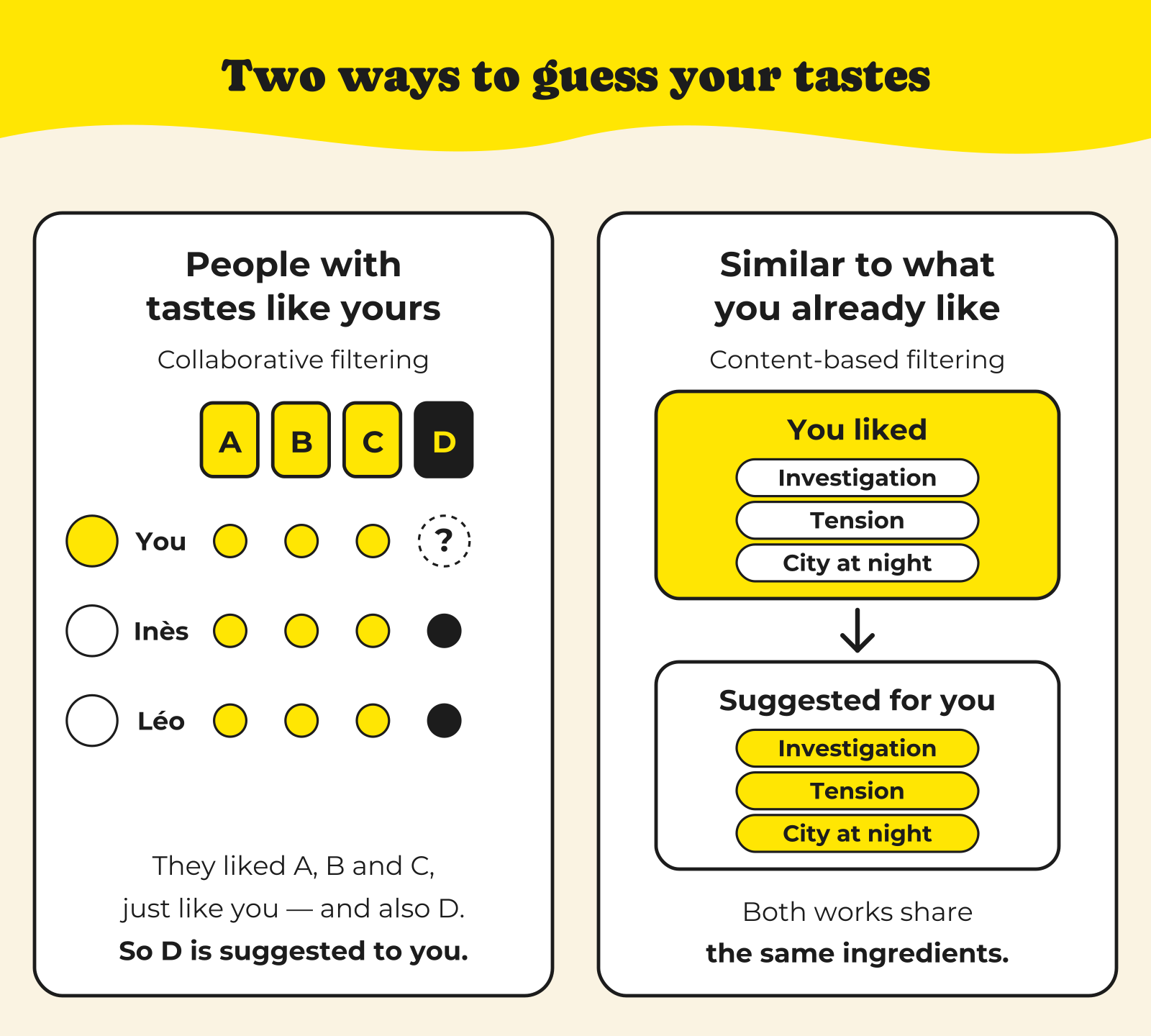
In practice, major platforms such as Netflix combine the two methods and use artificial intelligence to refine their predictions.
Not everything is personalised
Joëlle Farchy, an economist specialising in the cultural industries, compares these platforms to a supermarket : some products are placed at eye level because someone wants them to sell.
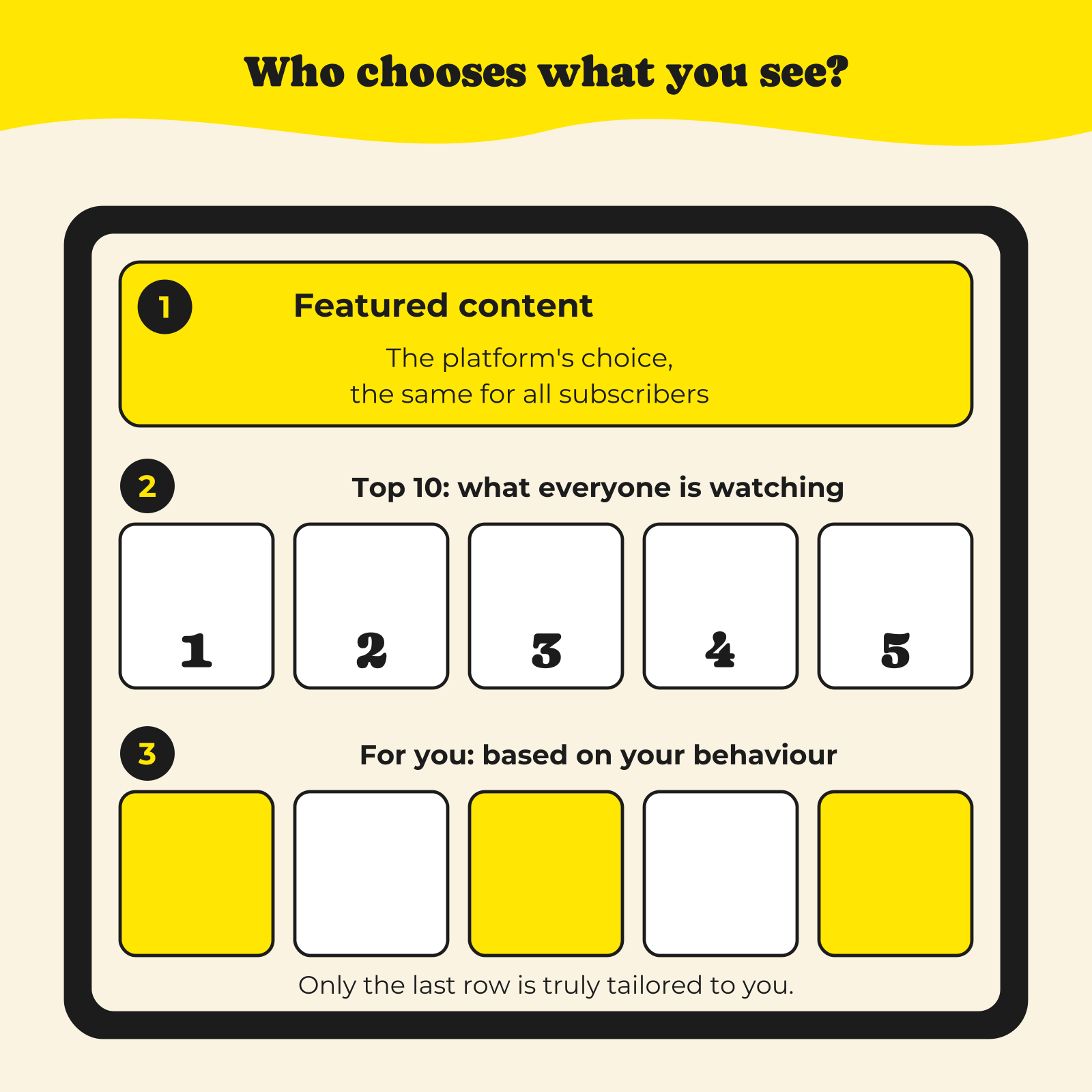
Some of what you see on the home page is therefore chosen by the platform itself, and is the same for all subscribers: a new original series it wants to launch, for instance. Rankings such as the “Top 10” show what everyone is watching. Only the rest is truly tailored to your behaviour.
When it works: real discoveries
When tuned well, these tools have a big impact. In a scientific paper published in 2015 , two Netflix executives explained that recommendations influenced the choice of roughly 80% of the hours watched on the platform. In other words, much of what we watch is something we did not search for ourselves.
And they can open doors. Joëlle Farchy points to Squid Game. After the series, Netflix suggests other Korean productions, and many European viewers discovered Korean series this way. In her view, the bubble that algorithms supposedly trap us in is more like a soap bubble than prison walls: it can burst.
The downside: going in circles without realising it
This risk has a name: the filter bubble , a term popularised in 2011 by American author Eli Pariser. By repeatedly showing you things similar to what you already like, the algorithm gradually narrows your horizons without you noticing.
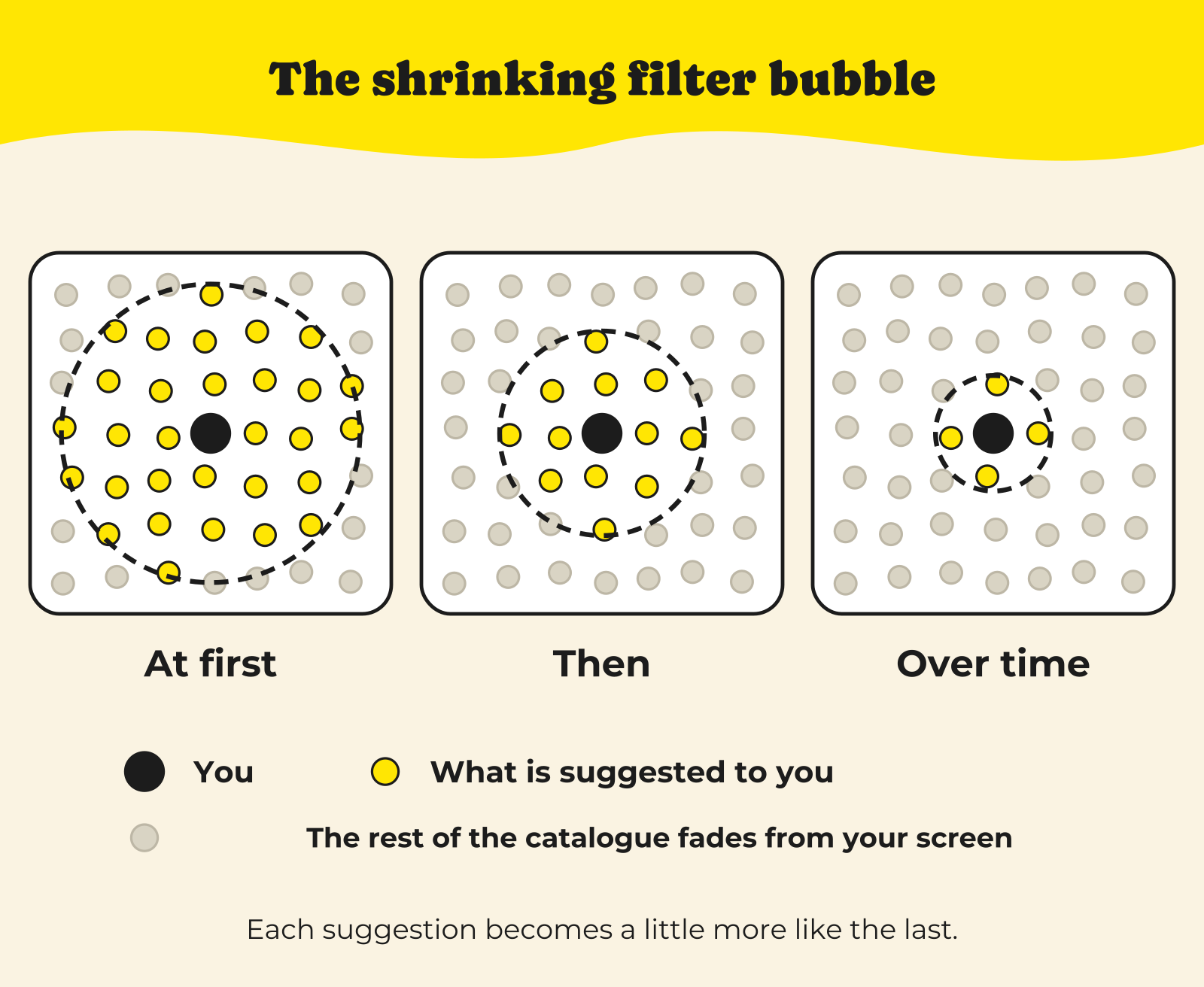
Discoveries close to home. Suggestions stray a little from your habits, but never very far. You feel as though you are exploring while staying in your comfort zone. The reason is mainly economic: too much diversity reduces the time spent on the platform , and that is exactly the metric it wants to increase.
An advantage for well-known titles. An algorithm learns from the ratings available. Yet the vast majority of works are hardly ever rated. In commonly used datasets, more than 95% of possible user–item pairs are empty, according to a study published in 2025 . Popular titles therefore get much better exposure. An analysis published by HEC Montréal gives an example: Amazon's “You might like” section mainly reflects purchases by millions of customers, amplifying what is already popular.
The issue is taken seriously even at the European Parliament , which called as early as 2021 for these algorithms to be regulated to protect cultural and linguistic diversity.
How to take control of your discoveries
You do not need to run away from algorithms. A few habits can help them work for you:
- Rate what you watch or read, including what you did not enjoy: a negative opinion is as informative as a positive one. On Gemster, you can also say that a suggestion does not suit you, and the app takes that into account.
- Go beyond the home page: explore the full catalogue, search by director or author, and browse less prominent sections.
- Vary your sources: a bookseller, a friend or a critic whose choices you enjoy can spot things no algorithm sees.
- Move between media: a story that stayed with you as a TV series often has a kindred spirit in a novel, manga or video game. That is exactly what Gemster helps you find.
An algorithm is still a tool. It can save you valuable time, but the best discoveries often come from your own curiosity.
Gemster's approach
That last habit is what inspired us to create Gemster. Our tastes do not stop at a platform's boundaries, yet most recommendations stay within a single catalogue: Netflix suggests films and series, Steam suggests video games, and your reading app suggests books.
Gemster is a free app that recommends films, TV series, video games, books, manga and comics. It relies entirely on the second recipe, the one that looks at the works themselves: it never uses other users' ratings, only yours. Each work is described through the feelings it evokes, its pace and its themes, not just its genre. And artificial intelligence plays no part in choosing or ranking the works suggested to you.
This choice solves one of the problems mentioned earlier. A little-known work does not need thousands of ratings to be recommended to you. And if you enjoy hidden gems, Gemster suggests them instead of constantly steering you back towards the latest hits.
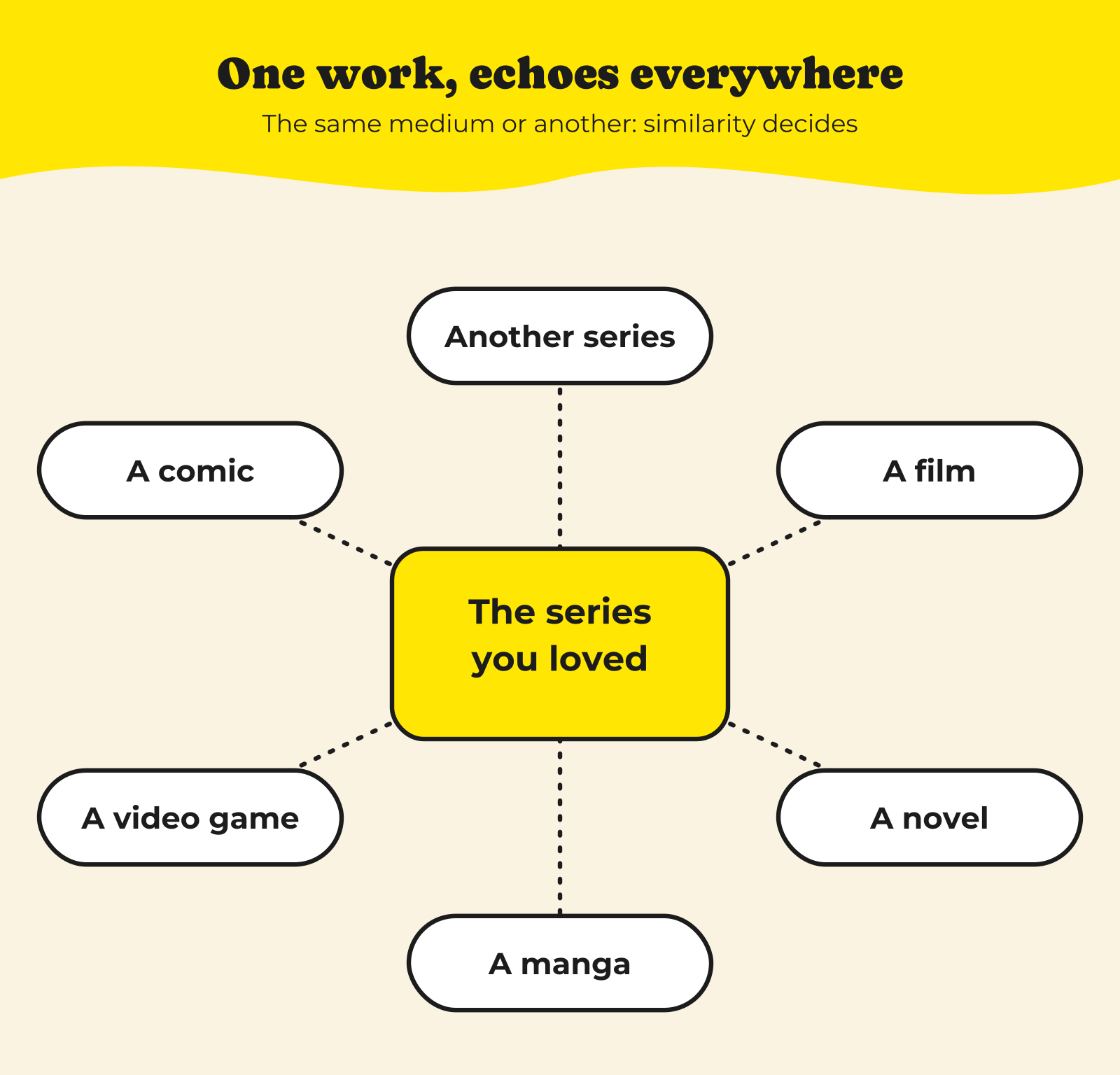
You can start with a particular work to find something that echoes it (Echo mode). Those echoes may stay within the same medium or come from elsewhere: after your favourite series, Gemster might suggest a novel or a game with a similar atmosphere, depending on what it finds closest. You can also start from your tastes as a whole (Expedition mode), optionally specifying your current mood and how much time you have.
That still leaves this method's weakness: going in circles. In Expedition mode, several safeguards address it:
- When your recent ratings all point in the same direction, Gemster puts less weight on it, so it does not lock you into a single style.
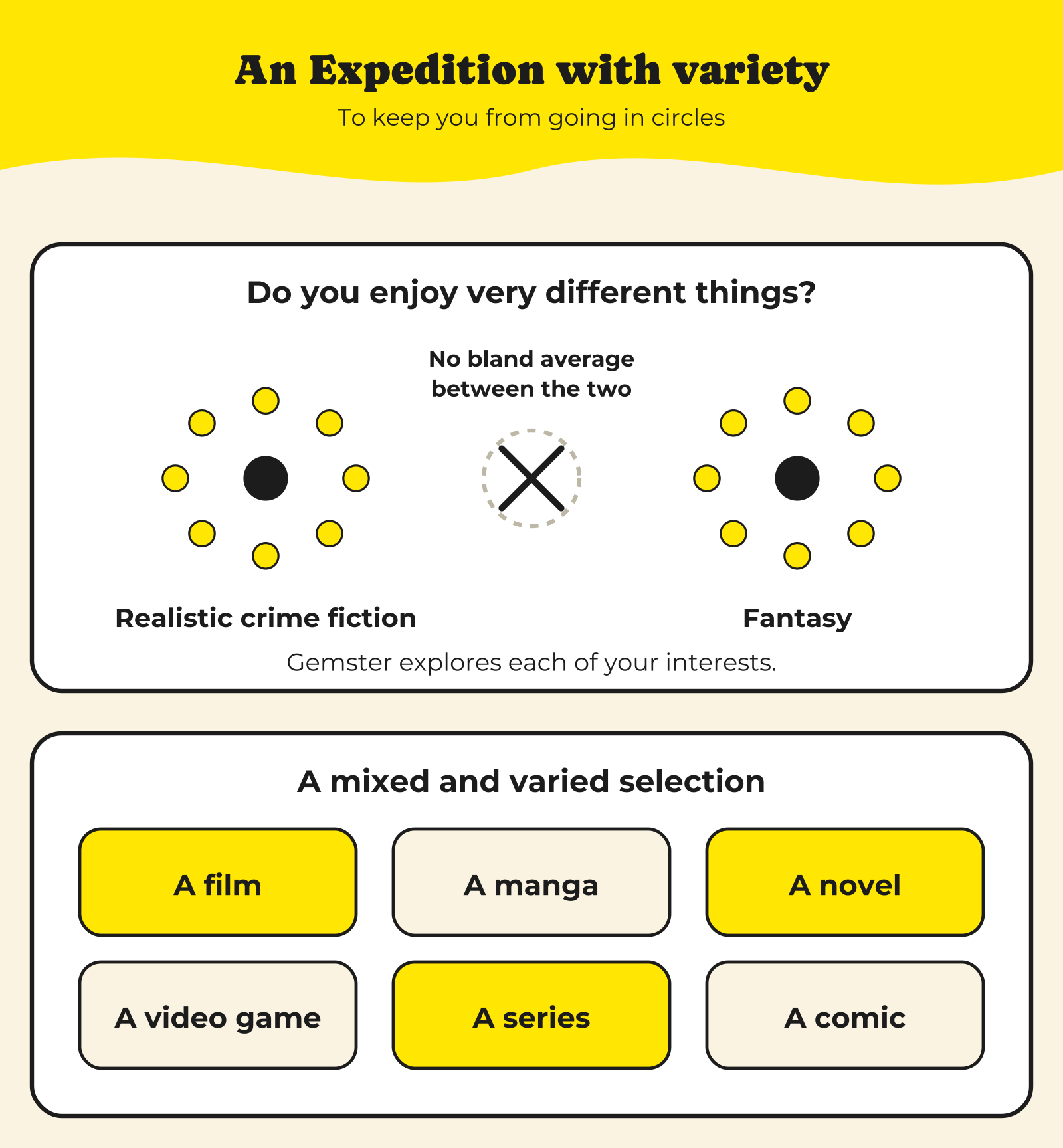
- When you enjoy very different things, from gritty crime fiction to wild fantasy, it searches around each of your interests instead of aiming for a bland average that would not reflect you.
- Each selection stays varied: no single subgenre or author can take it over.
- Media are mixed whenever possible, so a film night can also lead you to discover a manga.
Finally, each suggestion displays a score indicating how closely it matches your tastes, or your starting work in Echo mode. To get started quickly, you can import your history from Netflix, Prime Video, Steam, Letterboxd, Goodreads or MyAnimeList instead of rating everything by hand.
Sources and references
- Netflix — How our recommendations system works
- IBM — What is a recommendation engine?
- AI Observatory, Paris 1 Panthéon-Sorbonne University — Recommendation algorithms in culture (in French)
- C. A. Gomez-Uribe and N. Hunt — The Netflix Recommender System: Algorithms, Business Value, and Innovation, ACM Transactions on Management Information Systems (2015)
- Wikipedia — Filter bubble
- HEC Montréal — Algorithmic personalisation and cultural homogenisation (in French)
- Troupers — Recommendation algorithms and cultural diversity (in French)
- MDPI, Information — Volume 16, issue 2, article 151 (2025)
- European Parliament — AI technologies must protect cultural diversity (2021, in French)
- Photo: Jakub Żerdzicki / Unsplash